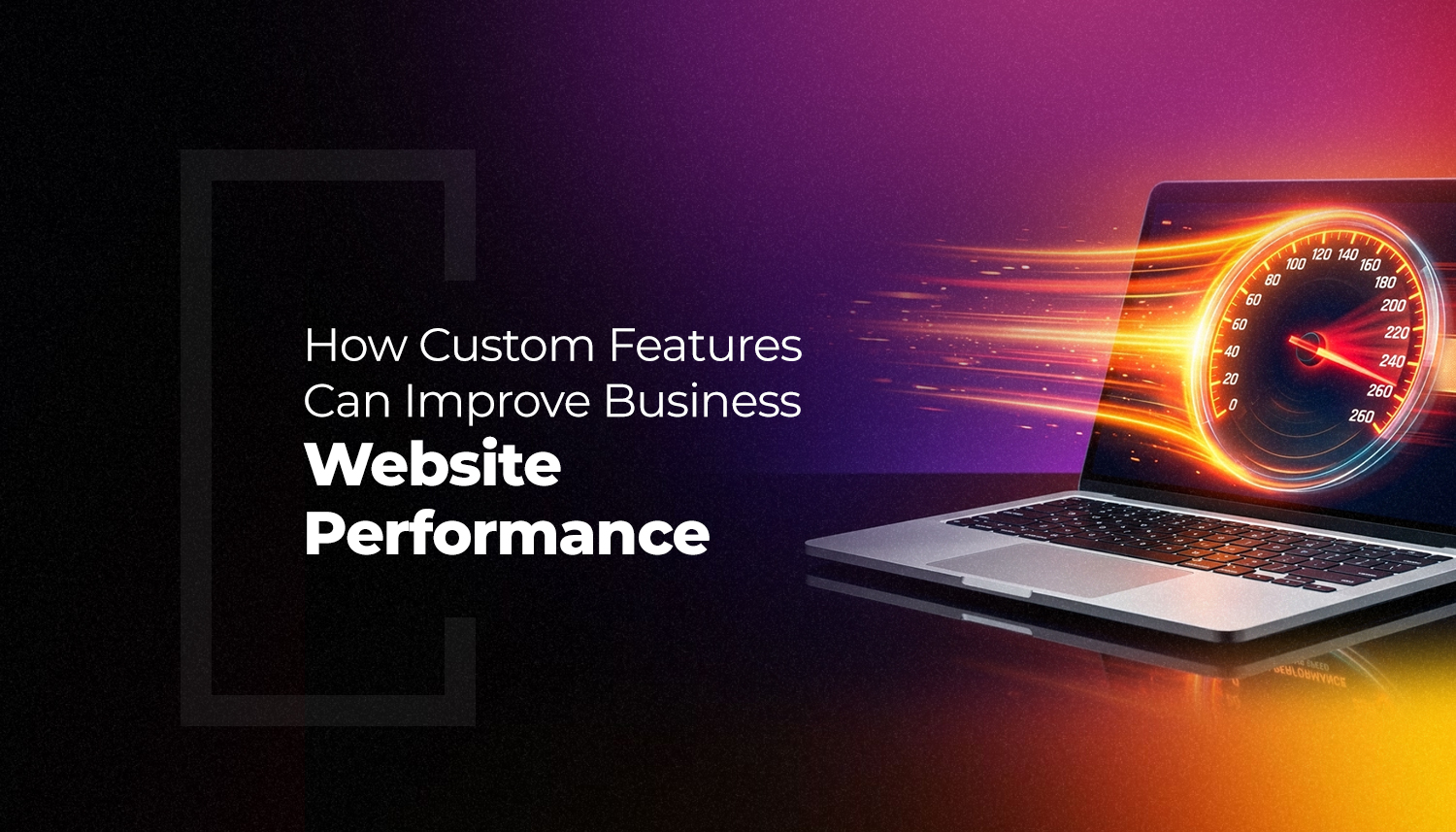
How Custom Features Can Improve Business Website Performance
- June 16, 2026
- Post By: Alex Mariyan Sebastian
Templates are fast and cheap to launch. But they come with compromises.
At some point, those compromises start costing you visitors, conversions, and credibility.
Custom website features change that equation. Built specifically around your business goals, your users, and how you operate, they let your website do things a standard template never could. The performance improvements that follow aren’t just cosmetic. They’re measurable.
This article walks through what custom features actually are, why they improve website performance, which ones have the most impact, and why getting them right requires the right team.
What is a custom website?
It means a website with any functionality that’s been built or configured specifically for your business.
Custom features are different from plugins or add-ons you install on a template. Plugins are prebuilt for general use cases. They work for most situations, but not perfectly for yours.
A custom feature is built to fit your specific situation. That’s a real difference in performance, flexibility, and how well it serves your users.
Why do template websites fall short over time?
Most template websites start to show their limitations within a year or two of being live. The visual constraints become obvious. Adding new features requires workarounds.
Load times creep up as plugins stack on top of each other. And as the business grows, the website can’t keep up without a significant rebuild.
For a template website carrying unnecessary code and unused features, that slowdown is almost inevitable as the site grows.
Template-based websites can be challenging to optimise Core Web Vitals because they may not allow you to make many changes to the underlying code. Developers have control over those scores with a custom-built site.
Which custom features have the biggest impact on performance?
Not every custom feature delivers the same return. These are the ones worth prioritizing.
1. Custom navigation and site structure
If users can’t locate what they want in a timely fashion, they leave. A custom navigation structure is created based on how your users think and what they are likely to be looking for, rather than on a template layout. This has a direct impact on time on site, pages per session, and ultimately on conversion rate.
2. Speed optimisation built into the code
A custom website can be built with performance as a foundation. Images are handled efficiently with next-generation formats and lazy loading.
JavaScript is loaded only where it’s needed. The codebase has no unnecessary plugins dragging it down. All of this has a direct impact on Google PageSpeed Insights scores, on Core Web Vitals, and on how many visitors actually stay long enough to become customers.
3. Custom forms and lead capture systems
Contact forms: General fields collect basic information. The data can be sent through to a custom form that can be used to qualify leads, route them to the correct individual, initiate follow-up processes, and integrate with your CRM or email application. This not only helps all enquiries to be processed quicker via the site but it also ensures that it is more consistent, which will boost conversion rates without the need to increase visitors.
4. Personalisation and dynamic content
The custom website allows the display of different content to different users according to their actions, location or access. If a visitor logs back in, he/she may see a different message on the home page than a new visitor does.
If a customer has looked at a certain product category and visits it again, they may be presented with similar products. Personalization increases the site’s engagement and relevance.
5. Integrated booking, e-commerce, or payment systems
The standard booking plugins and payment solutions are usually cumbersome and don’t integrate with the website.
The booking or e-commerce system is designed to be fully integrated with the website’s look and feel and operates exactly as the business does, with the ability to be directly integrated with back-end systems, including inventory, CRM, and accounting applications.
6. Mobile-first development
Over half of the web traffic is now via cell phones. Google ranks websites based on the mobile version of their site, this is called Mobile-First Indexing.
The mobile-first approach to designing a custom website helps it rank higher in search results, ensures faster loading speeds on mobile networks, and provides a user-friendly experience without compromising on mobile devices and tablets. Templates may not be mobile responsive, for instance, some features may not show on a mobile device and some elements may resize inappropriately.
7. SEO-ready architecture
A custom website can be designed from scratch to be optimised for search engines. The more structured the URL, the more structured the hierarchy is, the structured markup is more accurate, the faster the site loads, and the more easy-to-crawl the code, the better the ranking.
For these technical requirements, please see Google’s documentation on Search Central. Many of these factors are limited by the template design. With a custom build you have the full control of all the technicalities of your website from scratch.
8. Security and scalability built to your needs
Template websites rely on third-party plugins for most of their functionality. Each plugin is a potential security vulnerability, and outdated plugins are one of the most common entry points for website breaches.
The Federal Office for Information Security (BSI) consistently lists outdated web applications as one of the top causes of business security incidents. A custom website has only the code it needs, significantly reducing the attack surface. And as the business grows, the website can be expanded without having to rebuild from scratch, which is rarely possible with templates.
What’s the return on investing in custom website features?
It’s measurable. SMEs that invest in well-built custom websites are reporting significant returns. JJS CIT research indicates that small and medium businesses are seeing over 400% ROI from properly optimised custom websites. The same research notes that 53% of all website traffic comes from organic search and that SEO leads close at a 15% rate, far ahead of most paid channels.
Those numbers make sense when you consider what a well-performing custom website actually does. It ranks better, loads faster, converts more visitors, handles more traffic without breaking, and doesn’t need to be replaced every two or three years because it can’t keep up with the business. The upfront investment is higher than that of a template. The long-term cost is lower, and the return is significantly better.
How Inter Smart builds custom websites that perform
Inter Smart is a leading web designing agency in Dubai with a track record of building custom websites that deliver measurable results for businesses across industries. The approach at Inter Smart doesn’t start with design. It starts with understanding the business: what it does, who its customers are, what the website needs to achieve, and what’s currently holding performance back.
From there, every feature is built with purpose. Navigation is structured around how users actually behave. Load times are optimised at the code level, not patched with plugins. Forms, booking systems, and integrations are built to fit the business’s exact workflow. And mobile performance is treated as a core requirement, not an afterthought.
Inter Smart also brings deep technical SEO expertise to every project. As a trusted web designing company in UAE, the team understands Google’s ranking requirements and builds websites that meet them from the foundation. Core Web Vitals, structured data, crawlable architecture, and mobile-first design are built in by default, not added later.
If your current website isn’t performing the way your business needs it to, the answer usually isn’t more traffic. It’s a better website. Talk to Inter Smart to find out how custom features can benefit your specific business.

Get A Call back from Our Expert
Need tailored guidance or have specific questions? Simply request a callback, and one of our knowledgeable experts will reach out to you at a time that suits your schedule.