How to Build a High-Converting Digital Marketing Funnel
- February 27, 2026
- Post By: Alex Mariyan Sebastian
More traffic is useless if your funnel is leaking. The real profits come from conversion optimisation. From improving how well you convert the audience you already have.
The established approach allows companies to take their potential customers on a designed process, which starts with customer awareness and ends with the customer purchasing a product. By understanding the funnel better, your online marketing plan will be enhanced, no matter the level of business that you are at.
What is a digital marketing funnel?
A digital marketing funnel represents a framework that outlines the path of a consumer from being aware of a brand to buying and trusting that brand. It aids companies in formulating content that is specific to and strategies for each stage of the buying process.
The four primary phases
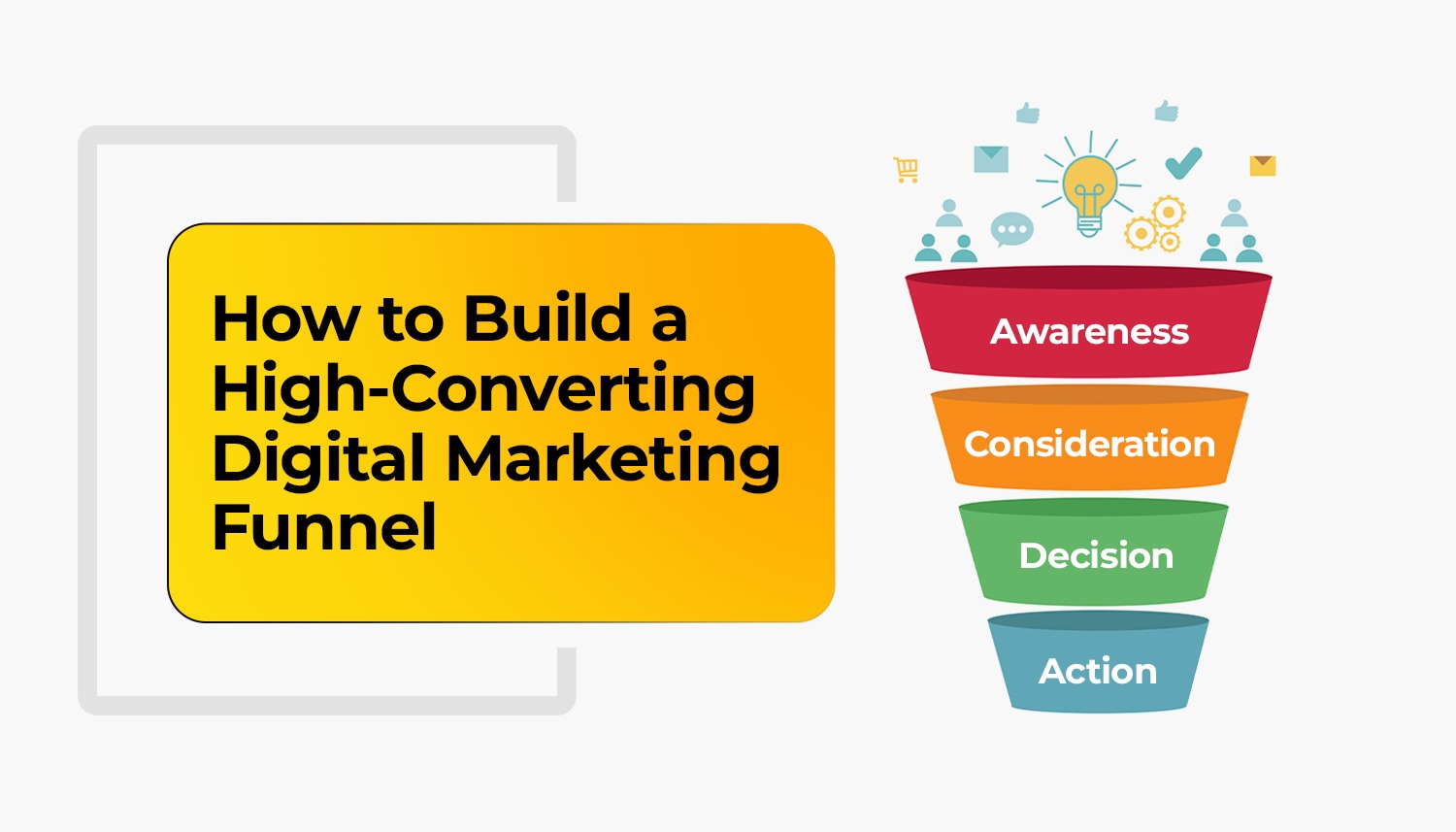
Awareness: People who may be interested in your products or services come across your brand. They are not aware of the fact that they have a problem yet. Or they are aware of the problem but not the solution you are offering.
Consideration: They are making a list of possibilities. Comparing products. Reading reviews. Searching for the best solution.
Decision: Purchase intent is there. Final doubts need to be addressed. Price, features, and trust are decisive.
Action: The purchase takes place. But that’s not the end. It’s the beginning of a long-term relationship.
Why is the Funnel Important?
The funnel is a great way to see the movements of visitors on your digital ground. It outlines the most significant moments throughout their journey from being aware of the product to actually consuming it.
Looking for the places where the potential customers are not going further in the buying process is just like trying to find and fix the leaks in a boat. You won’t be able to fix the broken parts if you don’t know which ones they are. Companies can now troubleshoot and solve the problems that exist at the identified critical points.
Funnel exploration lets you visualise the steps.
What is the right method to calculate the conversion rates?
You just have to divide the total conversions by the total number of visitors and multiply it by 100. A conversion means the action you want your visitors to take. It can be a purchase or a sign-up.

Stage-Level Tracking
Different stages of the funnel also have different conversion rates. The benchmarks for the conversions are as follows:
Lead → Marketing Qualified Lead (MQL)
MQL → Sales Qualified Lead (SQL)
SQL → Opportunity
Opportunity → Closed-Won Customer
Even a small change of one step can lead to doubling the revenues. Every 10,000 visits, where the number of opportunities will be increased to 18 to 25, will result in a large revenue growth, without any extra traffic.
Macro vs. Micro Conversions
Macro conversions: Core activities that drive revenue. Completed purchases. Demo requests. Free trial signups.
Micro conversions: Small actions that show that a person is engaged. Newsletter subscriptions. Guide downloads. Adding items to the cart.
Micro conversions aid in the diagnosis of funnel leakages. They are early warning signs.
What are the important metrics?
All metrics are not equally useful. Pay attention to business decisions driving ones.
Top-of-Funnel Metrics
Impressions: The total number of views your content got
Cost Per Click (CPC): How much does it cost you per click? Reduced CPC represents more effective advertisements.
Content Interaction: The duration of the visit, or how long they stay
Middle-of-Funnel Metrics
Page Views: Total number of views your page got
Branded Search Index: Number of people who searched your brand
Percentage New-to-Brand: Percentage of new visitors
Email Open and Click Rates: Number of opened emails
Bottom-of-Funnel Metrics
Conversion Rate (CVR): Percentage of total visitors that complete the desired task.
Customer Acquisition Cost (CAC): The cost of acquiring a customer.
KPI Return on Ad Spend (ROAS): Revenue per ads
Bounce Rate: Percentage of those who have viewed only one page.
The bounce rate is a pointer to the failure to integrate the advertisement and the landing page.
How to optimise every funnel stage?
There are tactics needed in each stage. One-size-fits-all doesn’t work.
Optimisation of the Awareness Stage.
Content Marketing: Videos, infographics, and blog posts. Helpful, educative and entertaining content. Not selling.
SEO: Organic presence of the associated keywords. Google refers to high-quality traffic.
Social media ads: Instagram, Facebook, TikTok, and LinkedIn.
Influencer Partnerships: Recommendations by credible influencers.
Consolidating the Consideration Stage
Email Campaigns: Add value by personally reaching out via email.
Retargeting Ads: Recalling past visitors.
Converting in the Decision Stage
Personalised Offers: Customised offers for customers.
Live Chat Support: Reduce purchase barriers by being easily accessible.
Streamlined Checkout: Multiple payment options and easy checkout.
Nurturing the Loyalty and Advocacy Stage
Post-Purchase Email Sequences: Usage tips and product suggestions.
Loyalty Programmes: Rewards for repeat purchases.
Referral Incentives: Encourage customers to recommend to others.
Which tools are essential for funnel tracking?
The right tools make data collection and optimisation possible.
Analytics Platforms
Google Analytics 4 serves as the essential element which businesses need to create their conversion tracking systems. The platform enables users to create conversion goals, which they can track to monitor user activity, and they will learn about their traffic sources.
Mixpanel enables users to track their activities through its funnel analysis system. The system demonstrates the exact points where users abandon their tasks.
Hotjar provides heatmaps together with session recordings. The platform explains user behaviour through its detailed data analysis. The system tracks user clicks together with their scrolling distance and their points of interruption.
A/B Testing Tools
Google Optimise, Optimisely, and VWO. Businesses use the tool to evaluate different website elements through testing. Testers will examine multiple variations of. Testers will examine multiple variations of. Testers will examine multiple variations of. Testers will examine multiple variations of. Testers will examine multiple variations of.
A/B testing serves as a fundamental requirement for businesses.
Email Marketing Platforms
Mailchimp, ActiveCampaign, and HubSpot. The system uses automation to create nurture sequences, which include automated message sending based on specific customer segments to deliver tailored content, while performance metrics are monitored through the tracking system.
CRM Systems
Salesforce, HubSpot, and Pipedrive. The system enables users to monitor their sales process, which starts with lead identification and ends with lead conversion. The system enables users to identify their sales process constraints. The system enables users to improve their sales process results at every stage of their sales process.
What are the biggest funnel mistakes?
Even experienced marketers often stumble. Here are the most common mistakes.
Missing Content Gaps
Stage gaps occur when content is missing for specific parts of the customer journey. Solution: Audit your funnel. Identify gaps. Create targeted content to fill them.
Misaligned Content
What you share doesn’t match where customers are in their journey. The result: No resonance. No conversion.
Fix: Carefully map your content to specific stages and customer questions. Awareness content doesn’t sell. Decision content doesn’t educate.
Traffic Focus Instead of Conversion Focus
More traffic won’t fix a leaky sales funnel. Real profit comes from improving how well you convert the audience you already have.
Overly Complicated User Journeys
Complicated or confusing user journeys. Too many form fields. Unclear navigation. Multiple unnecessary steps. All of this leads to drop-offs and abandoned carts.
Solution: Map your funnel from landing page to conversion. Identify friction points. Minimise form fields. Ask only for the necessary information.
Lack of mobile optimization
80%+ of users are on mobile. If your content doesn’t look and work perfectly on mobile, you’ll lose the majority of your audience.
Solution: Mobile-first design. Responsive layouts. Touch-optimised CTAs. Fast loading times on 3G/4G.
How to effectively automate funnel processes?
Automation saves time and ensures consistent, personalised engagement.
Email Automation
User behaviour drip campaigns. Someone downloads a guide? Send a follow-up with related material. Someone abandons their cart? Send a notification accompanied by a reward.
Automation: Fine-tuning automation by data. It is possible that the response rates would be much higher when there is a wait of three days as opposed to a wait of one day before a follow-up email.
Retargeting Automation
Pixel-based tracking. Ads will be automatically served to individuals who have been viewing a particular page but failed to convert.
Existing ads can be turned into dynamic ads, which would display products seen previously or similar items and trigger interest and action.
Lead Scoring
Engagement-based automatic scoring. Email opens. Link clicks. Page visits. Download activity.
Those scoring high are targeted for sales outreach. Learners with low scores are better nurtured.
How to maintain continuous testing and optimisation?
Digital marketing funnel is not a set-and-forget kind of tool. It is a life cycle which has to be taken care of.
Systematic A/B Testing
Test one element at a time. Headlines. CTAs. Images. Form length. Button colour.
Run tests long enough for statistical significance. Stopping too early leads to false conclusions.
Document results. What worked? What didn’t? Why? Build a knowledge base.
Heatmap Analysis
Where do users click? Where do they not scroll? Which elements do they ignore?
Heatmaps reveal patterns that raw data misses. They show intention, attention, and confusion.
Session Recordings
See individual user journeys. Where do they get stuck? Where do they get frustrated? Where do they give up?
The combination of both qualitative insights and quantitative data creates a complete understanding of the situation. The two elements provide an extensive understanding of the complete situation.
Regular Funnel Audits
The process starts with a quarterly review, which assesses the performance of each stage, detects bottlenecks and develops optimisation priorities. The team will start their work by addressing the stage which generates the highest revenue loss. The process of improving this weakness will create benefits which will extend to both marketing and sales functions.
Conclusion
Out of 10,000 website visitors, only an average of 4 become customers. That’s the harsh reality of an average funnel with a 2.35% conversion rate.
But top performers achieve over 5.31%. The best achieve 11.45%. The difference? Obsessive focus on conversion optimisation.
A high-converting funnel is based on: Clear measurement of every phase. Content that matches each funnel stage. Frictionless user experience. Continuous testing and optimisation. Automation for scaling.
The tools are available: Google Analytics. Hotjar. A/B testing platforms. Email automation. The principles are proven: Understand the user journey. Identify bottlenecks. Systematically optimise.
Inter Smart lives by these principles. As a leading website development agency, we build conversion machines. Not just pretty websites. Systems that transform visitors into leads, customers, and advocates.
Our clients see measurable results: Higher conversion rates. Lower CAC. Better ROAS. Sustainable, profitable growth.
Invest in a data-driven, optimised funnel. Contact Inter Smart today.
Learn how we build high-converting funnels that transform traffic into revenue.
Get A Call back from Our Expert
Need tailored guidance or have specific questions? Simply request a callback, and one of our knowledgeable experts will reach out to you at a time that suits your schedule.