How Web Design Impacts Your Brand’s First Impression
- April 24, 2026
- Post By: Alex Mariyan Sebastian
Your website isn’t just a place where people find your contact info. It’s the first thing that most visitors see of your brand. It influences their perception of you even without reading a word of what you have to say, communicating with your staff, or even seeing your product in action. The first impression counts in your favour if you get the design perfect. Make a wrong choice, and even a huge marketing budget will not retain visitors on the site.
According to a peer-reviewed article in the journal Behaviour & Information Technology, visitors develop a visual impression of a website as fast as 0.05 seconds. During that fraction of a moment, they determine whether your site is worthy of their time and looks trustworthy and professional. Otherwise, they quit. And they’re unlikely to come back.
How quickly do people judge a website?
Faster than you’d think. Studies conducted by CXL indicated that out of 100 comments made by a visitor concerning a site, 94% of it is about design and not content. These are not the initial seconds that people are reading your homepage copy. They are responding to layout, colours, the pictures and the general impression of the page. It is only when that visual impression goes by that they tend to hang around long enough to read something.
In competitive markets such as Dubai and the UAE in general, where customers have numerous choices and high expectations, those milliseconds are literally commercial. When a visitor arrives on a well-designed website, they are much more likely to be convinced to remain, browse and make a conversion than visit an old-fashioned or hard-to-navigate website.
What exactly creates a strong first impression in web design?
It’s not one single element. It’s the combination of several things working together, and when any of them are off, the whole impression suffers.
Visual clarity and hierarchy
With a properly designed website, it is instantly apparent what the business is, who it is aimed at and what the visitor considers next. This happens by visual hierarchy: the strategic application of size, weight, contrast and space to direct the eye. Hierarchy done well makes a visitor not have to work to comprehend the page. Their eye is directed by default to the most significant component and then to the next, and they are directed to a call-to-action feeling and not puzzled.

Apple uses visual hierarchy cleverly by using ample white space and bold lettering. The scaling of the images and typography also matters when it comes to visual hierarchy.
Consistent, professional visual identity
The use of colours, fonts, pictures and spacing should be uniform across the site. The slightest inconsistency, even, generates the sense of an indistinct unease which visitors can never quite name but which they can certainly experience. The appearance of a brand online is a clue that the business is put-together. The converse is true as well. Poor matching of fonts, incompatible colours or low-quality images do not fit well for credibility, even before one has subconsciously evaluated them.
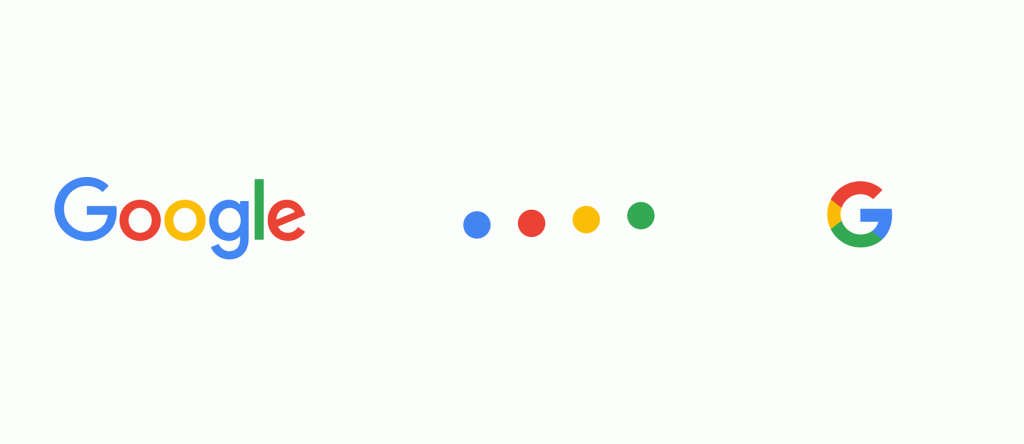
Google’s visual identity is unmistakably unique in using lettering and colour palettes.
Load speed
Speed is part of the first impression, too. A slow site is not only annoying to the visitors but also an indication of something amiss. Based on the Page Experience guidelines by Google, the performance of a website is a direct determinant of the way Google rates and ranks websites. And as a user, there is a 4.42% decrease in conversion rate per second of load time variation between zero and five seconds. Quickly loading pages are more credible, utilised more and tend to convert.
Mobile experience
Statista records that more than 60% of the total web traffic worldwide is generated by mobile devices. To make matters worse, Google indexes on Mobile-First, which means that it indexes your mobile version of the website, then uses this to judge and rank you. A website that looks polished on a desktop but breaks down on a phone isn’t just a bad user experience. It is actively damaging your rankings in search engines and creates a bad first impression among most of your visitors.
Navigation and structure
When a visitor fails to determine what to browse after a few seconds, they will feel lost. If the logical navigation is clear, it minimises friction and makes people navigate through the site.
One of the most prevalent underlying reasons for high bounce rates is poor structure, where the visitor comes to a page and never does anything any more. This can be directly measured by Google Analytics 4 using the metrics of engagement rate, and a high bounce rate is a clear indication that something is driving people away prematurely from the experience.
Does web design affect SEO and user experience?
Yes, directly. Core Web Vitals of Google are performance indicators which assess the performance of a page in terms of loading speed, visual stability and responsiveness to user input. These measures are included in the Google ranking algorithm. With a poorly designed site that has low Core Web Vitals, it will not be ranked as high as a less attractive site that is technically better.
In addition to the technical aspect, Google also considers the quality of content using its E-E-A-T model (Experience, Expertise, Authoritativeness, Trustworthiness). An expertly built website that provides the information in an easy-to-understand manner and displays qualifications, demonstrates actual work and provides easy access to the business indicates power and credibility to the visitor and the search engine. Design and SEO are not fields on their own. Good design helps in higher rankings when well-designed, and higher rankings attract more of the right people to a well-designed site.
What are the real business consequences of a poor first impression?
They cost more than the majority of businesses. According to an Adobe study, one out of every three consumers is likely to leave a website because of the unappealing layout or content. It’s almost four out of ten visitors who walk out before you even show what you really have to offer. And 88% of users say they wouldn’t return to a website after a bad experience, according to research cited by Thunderbolt Digital.
For businesses spending money on paid search, social media ads or SEO, poor design is a direct drain on return. Traffic that arrives and immediately bounces is traffic you’ve paid for without getting anything back. Every pound or dirham spent bringing someone to a website that doesn’t hold them is money spent creating a negative impression of your brand.
In markets like Dubai, where consumer expectations are high and competition is intense across almost every industry, a weak digital presence isn’t neutral. It actively sends potential customers toward competitors who’ve invested more carefully in how their brand presents itself online.
What makes a first impression last, and what makes visitors come back?
They get through the door by the first impression. The richness of experience behind it is what holds them.
A website that creates a good impression and then follows up on that impression by providing clear content, value-added information and navigation that works creates the sort of trust that helps to transform a first visit into an inquiry, and the inquiry into a customer. The appearance of websites that are difficult to navigate produces a certain type of disappointment. It was expected that it would be like this, and it was not so.
This is why making design choices must be based on real-life user navigation and not on the aesthetic value of a site. It is not to win a design award. The aim is to ensure the visitors feel confident, informed and prepared to move on to the next step. That needs to know who they are, what they seek and what will make them put trust in you and act.
How Inter Smart approaches web design differently
Inter Smart is a top web design company in Dubai with a clear perspective on design. Every choice, from a home page layout to the weight of a button, influences the visitor and their next action. That connection between visual choices and real business outcomes is what drives the work.
As an experienced web designing agency in UAE, Inter Smart works with businesses across industries and sizes, and the starting point is always the same. Who is the audience? What do they need to feel before they’ll act? And what does the present location do well or badly to do that? The design is informed by the answers, rather than the other way round.
The outcome is lightweight websites that perform well on mobile and load quickly, communicate effectively and direct visitors to make a choice.
When your website is not creating the first impression your brand is worthy of, then that is a problem that can be solved.
Talk to Inter Smart and find out exactly what’s holding your site back and what a properly designed website could do for your business.

Get A Call back from Our Expert
Need tailored guidance or have specific questions? Simply request a callback, and one of our knowledgeable experts will reach out to you at a time that suits your schedule.