Before & After: How a Website Redesign Increased Engagement Rate by 180%
- March 18, 2026
- Post By: Alex Mariyan Sebastian
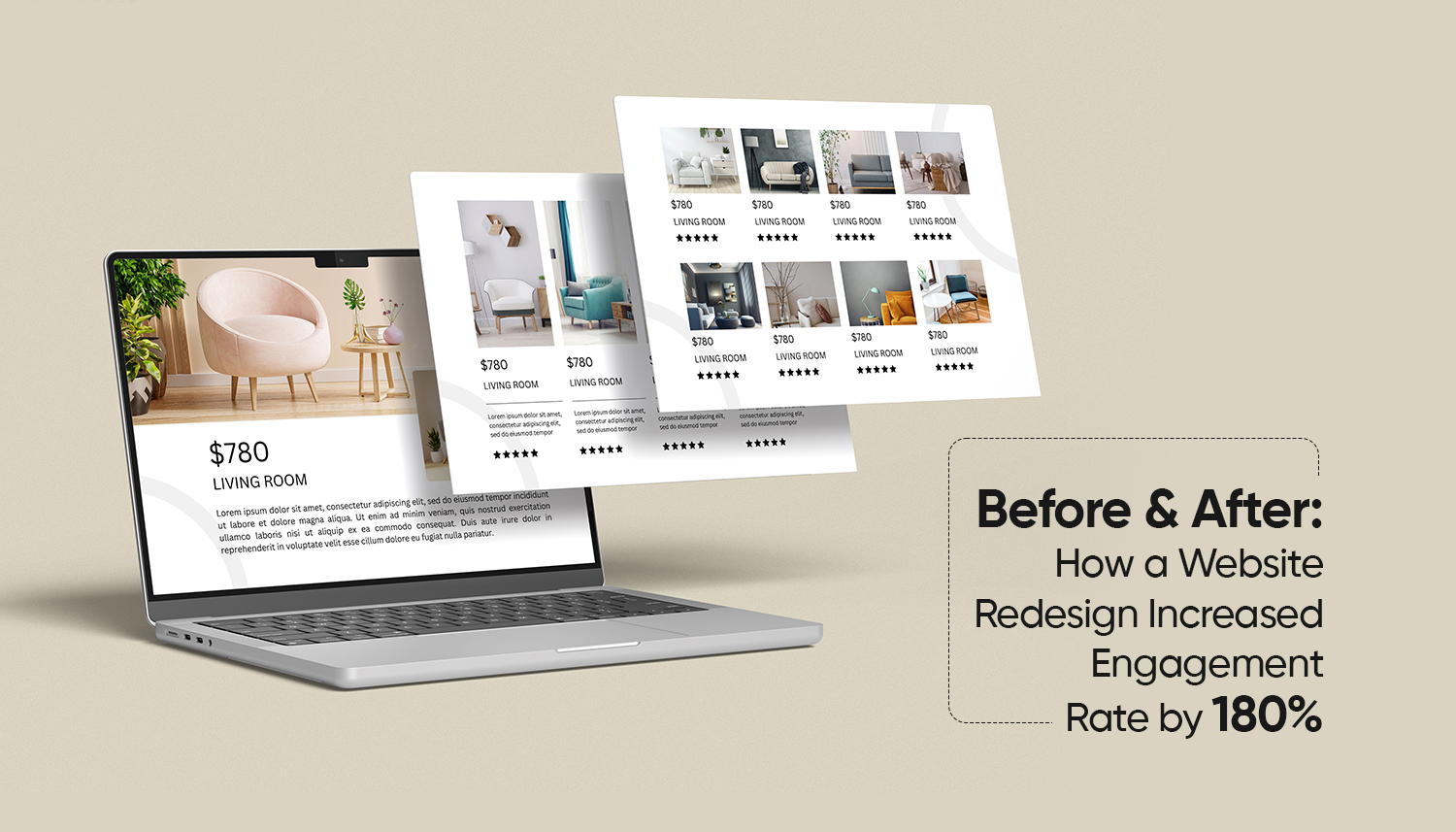
An outdated website doesn’t keep visitors. It drives them away.
Any person who visits a site that takes time to load, does not support smartphones or lacks a proper structure will be out of the website within seconds. And this occurs every day, silently and unexpectedly, whilst the owner believes that the site is operating as intended.
That is essentially altered by a carefully considered redesign. It is not that a new design is necessarily superior, but rather a great redesign solves the correct issues: bad usability, slow performance, and user-unfriendly navigation. The outcome is quantitatively improved measures. Reduced bouncing, higher dwell times, increased number of pages per session and finally, a very high degree of engagement.
This article will demonstrate what usually happens in the redesign, why it happens, and what is important.
What is engagement rate?
Engagement rate is a metric that measures the extent of interaction of visitors with a site. Google Analytics 4 also considers an engaged session one that takes at least 10 seconds, generates a conversion or has two page views. The engagement rate is the reverse of the bounce rate and shows the proportion of active sessions.
The typical indicator of a site that does not impress visitors is a high bounce rate and low dwell time. Customers arrive, take a glimpse, cannot find what they seek, or fail to get an immediate clue on what the organisation provides and go away. This is the very issue that is dealt with by the redesign.
Step-by-Step: How A Redesign Is Implemented
A design that makes a difference does not start with design. It begins with analysis. This is the way Inter Smart undertook this project.
Step 1: Full Analysis of the Original Situation
The analysis of the existing website was conducted closely before the first line of code had been written or a design element modified. What were the remaining organic rankings? But what was really being read? In which locations were users falling out? The data was given by tools such as Google Search and Google Analytics. This inventory is not a step to be undertaken out of choice; it is the basis on which all the other decisions will be made.
Step 2: Rethinking User Paths
A website isn’t a shop window. It’s a path. Tourists come with a purpose, and they need to be taken to their destinations. The user paths have been reorganised completely in the redesign. Every single page has a single purpose, and every single page will bring you to the next one. Navigation was simplified, subpages were effectively pulled together, and the content flow was structured in a manner that allows the visitor to naturally know where to go next.
Step 3: Mobile First since the beginning
Its new design had been created with mobile first and desktop second. It may seem an insignificant fact, but it is essential. Google has also introduced evaluations of websites on the basis of mobile-first indexing, which implies that the ranking of a webpage is based on the mobile version of a webpage. A site that is beautiful on the desktop is barely usable on a cell phone, and there is a major issue.
Step 4: Maximise Technical Performance.
The times the loading took were a quantifiable issue. The images were not compressed, the theme required too much JavaScript that was not necessary, and it was not a performance-orientated hosting setup. All images were optimised, the code was cleaned, and lazy loading was used in the redesign. Those results were instantly seen in the Google PageSpeed Insights. The ranking was reflected by the web vitals, which improved significantly.
Step 5: Edit and Narrow down Content
Sometimes, a lot of text does not imply a lot of impact. The first site was cumbersome and well-written with no visible structure. In the redesign, the content was cut to the bare basics and divided into concise segments and was clearly separated with subheadings. The right places were used to place calls to action, not everywhere and not in the corners. Each page now conveys the main idea and ends with a definite call to action.
Step 6: Staging, Testing, Launch
Development and testing of the new design were done as a complete staging design and then taken live. All the old URLs were redirected, all forms were tested, and all technical seo settings were verified. The site was only made live after a full test run on the staging environment and submitted straight to Google Search Console with the new sitemap.
What changes after a professional redesign?
That’s the crucial part. A redesign isn’t an end in itself. It’s not about making the website look new. It’s about making it work better. And that can be measured.
Here’s a typical before-and-after comparison of the most important metrics:
| Metric | Typical Before | Typical After |
| Bounce Rate | 65 to 75 % | 30 to 40 % |
| Time On Site | under 1 Minute | 2 to 3 minutes |
| Pages per visit | 1.2 to 1.5 | 2.8 to 3.5 |
| Conversion-Rate | under 1% | 2 to 4% |
| Mobile Usability | Limited | Full |
| Overall Engagement | Baseline | Up to +180 % |
Sources: Google Search Central, Nielsen
What made the difference?
That’s the question most people are interested in. No redesign is a sure thing, and not every new design leads to these results. What worked in this case can be broken down into a few key points.
Design that guides instead of confusing
The old design didn’t offer a clear hierarchy. Visitors didn’t know where to look or what to do. The new design has a clear visual structure: What’s important is also visually prominent. What’s meant to trigger an action actually looks like a call to action.
Speed as a prerequisite
Slow pages lose visitors before they’ve even seen any content. Google has long since integrated this into its ranking algorithm. If a page loads quickly, the bounce rate drops almost automatically. This isn’t a design issue; it’s a technical issue with directly measurable effects.
Mobile as the primary channel
More than half of all visits to this company came from mobile devices. The old website was barely usable on these devices. That alone explains a large part of the high bounce rate. Mobile First isn’t a trend; it’s a reality.
Clear content instead of cluttered pages
Less is more. Content that gets straight to the point and is clearly structured keeps visitors on the page longer. Long, unstructured texts do the opposite. The revised content was shorter, more direct, and easier for visitors to grasp.
How Inter Smart Delivers These Results
A redesign that delivers these improvements doesn’t happen by chance. It requires a process that integrates design, technology, and content, and a partner who understands what matters.
Inter Smart is a leading web design and development agency. Every redesign project begins with an honest analysis of the existing website, not with design drafts. What works? What’s costing visitors daily? Which SEO rankings need to be maintained? Only once these questions are answered does the real work begin.
The result is websites that load quickly, function flawlessly on all devices, guide visitors clearly, and measurably generate more engagement, more enquiries, and more revenue.
If your website has visitors but isn’t generating results, that’s not bad luck. It’s a solvable problem.
Contact Inter Smart and let us show you what’s possible for your website.




Get A Call back from Our Expert
Need tailored guidance or have specific questions? Simply request a callback, and one of our knowledgeable experts will reach out to you at a time that suits your schedule.