API Integration Challenges for Dubai Enterprise Websites
- October 6, 2026
- Post By: Alex Mariyan Sebastian
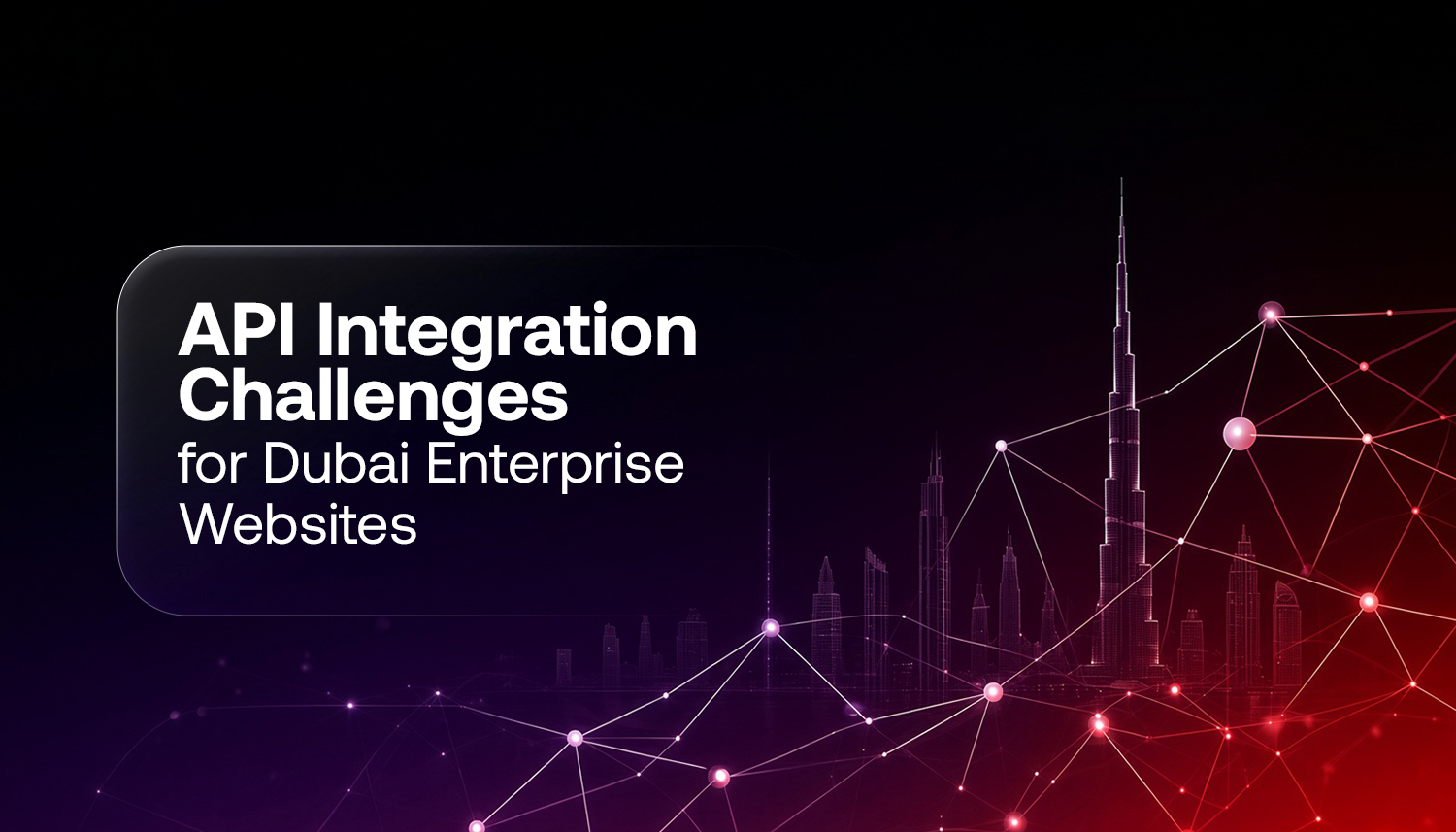
API integrations are a key part of modern IT systems. They help apps communicate with each other, move data, and run tasks without manual steps.
When everything goes well, daily operations run faster, and errors drop. If it is done carelessly, it can open security gaps, break steps in the process, and send results that people cannot trust.
In this article, we will look at frequent problems that show up during API work with enterprise sites in Dubai. We will also cover practical ways to deal with each one.
| An API, or Application Programming Interface, is a set of rules. It lets two programs talk to each other. With API integration, systems can share data and keep the handoff from turning into manual work. |
What are the most common API integration challenges?
Here are the challenges that most consistently come up in enterprise web projects in Dubai.
1. Legacy systems that weren’t built for modern APIs
Many enterprises in Dubai have been running the same ERP or back-office systems for a decade or more. These systems predate the current era of REST APIs and cloud connectivity. They use older protocols that modern web platforms don’t natively support.
Connecting them to a new enterprise website usually requires building a middleware layer, essentially a custom translator that sits between the old and new systems. This adds cost and complexity and must be maintained as both systems evolve.
2. Data consistency across integrated systems
When two systems share data via an API, they must use the same kind of format and layout. In real work, a customer entry in a CRM can look unlike the same customer in an ERP. The field titles may be different. Dates can be written in different ways. Even a phone number can be saved in separate formats across tools.
If the integration team does not plan for these gaps, the outcome can be more than one copy of the same record. Data may not show up where it should. Some actions may break and not show a clear error right away. For a large business that runs hundreds or even thousands of events each day, the issue grows fast.
3. UAE compliance and the PDPL
If an API deals with personal data in the UAE, it must follow the UAE Personal Data Protection Law. This is Federal Decree-Law No. 45 of 2021, often called the PDPL.
The PDPL explains what can and cannot happen to personal data. It covers collection, storage, processing, and sharing. It also places limits on sending personal data out of the UAE.
For companies that rely on outside SaaS tools, cloud-based CRMs, or payment services that work globally, this is not simple. The API design must consider where data will live and how data will be moved from the start. Fixing it after launch can be hard and risky.
Free zones in Dubai can add more complexity. DIFC and ADGM follow their own data protection rules.
4. Payment gateway integration in the UAE
The UAE payment landscape is fragmented. Big companies often use more than one payment gateway. Some work with Telr, PayTabs, Network International, or Stripe. Other times they also add options like Apple Pay UAE or a local bank direct debit. Each provider sets things up in its own way. The API format can differ. Auth rules are not the same. Test sandboxes are different too.
Enterprise payments also bring extra steps. Many deals use multiple currencies. Corporate buying can follow its own process. There are also split payment cases that do not match the usual gateway docs. To handle this, the system needs solid API design. It also needs testing that covers real flows before launch.
When a payment fails in an enterprise setup, it is not only a missed transaction. The customer can lose trust. Contract terms can be impacted as well.
5. Government and regulatory API portals
Several sectors in Dubai require direct integration with government systems. Real estate platforms need to connect with DLD (Dubai Land Department) systems. Healthcare providers integrate with DHA (Dubai Health Authority) portals. Logistics companies link to customs and trade platforms. HR and payroll systems often need WPS (Wage Protection System) integration.
These government APIs tend to have stricter authentication requirements, less flexibility in their data formats, and more limited documentation than commercial APIs. They also change periodically when systems are updated, which can break existing integrations if maintenance isn’t built into the project plan from day one.
6. Arabic language and RTL interface requirements
In Dubai, big company sites usually run in both English and Arabic. Teams also have to deal with right-to-left page layouts.
When an API sends content to the front end, it must manage more than just how it looks.
It needs to set the text direction and character encoding correctly. It also has to apply language-specific formatting in the data itself.
If the API provides product names, descriptions, or messages without the right language tags, the Arabic view can break.
It may show the text in the wrong way instead. This is a detail that gets missed in generic integration projects and only surfaces when Arabic users start testing the platform.
7. API rate limits and performance under load
Most outside APIs set limits. They control how many calls you can make each second or each day. For small sites, this usually does not cause trouble.
On bigger systems, it shows up fast. Think of enterprise apps with thousands of users at the same time. A hard limit can slow things down or even make requests fail.
Say a catalogue page loads and it pulls stock data right away. If it calls an inventory API on every page view, the count climbs fast. Now add a limit of 100 requests per minute. You reach that ceiling quicker than you expect.
In well built enterprise integrations, teams avoid that pattern. They use cached results, they place tasks in a queue, and they fetch data without blocking the page. This keeps the traffic under the limit and still helps users see up to date info.
How should enterprise API integration be approached to avoid these problems?
The challenges above are solvable. They need a clear plan from the beginning. Not a stop-and-start cycle after something fails.
- First, list every system that must be tied together. Then spell out what each integration sends and receives. Also note the rules for each kind of data before you write any code.
- Next, set up the data model before you build any API. Have one common structure that all linked systems use. This helps avoid mismatched fields later.
- Add compliance at the start. PDPL duties, data residency rules, and any industry requirements should be built into the design from day one. Let the design reflect the audit needs, not the other way around.
- Validate everything in staging. Make the setup look like production. API links can act differently under real traffic and with real data size.
Testing only in development misses the failures that matter most.
- Plan for maintenance. Third-party APIs change. Government portals update. Build a monitoring and maintenance schedule into the project so that when something breaks, it’s caught early and fixed fast.
How Inter Smart handles API integration for enterprise clients in Dubai
Inter Smart is a web development company in Dubai that has worked on complex API integration projects across retail, healthcare, real estate, and logistics sectors in the UAE.
The process starts with a technical discovery phase. Before any development begins, the full integration architecture is mapped: what connects to what, what data is shared, what compliance obligations apply, and where the technical risk points are. That upfront clarity prevents the most expensive mistakes.
For legacy system challenges, Inter Smart builds custom middleware where needed. For payment gateway integrations, testing covers multiple currencies, edge cases, and failure scenarios, not just the happy path. For government portal integrations, the team works within the specific constraints of those systems and builds monitoring to catch any changes post-launch.
As a web development company in UAE with direct experience in the local regulatory environment, Inter Smart understands the PDPL implications of data flowing between integrated systems. Compliance isn’t added at the end. It’s designed into the architecture from day one.
If your enterprise website needs to connect to multiple systems and you want it done properly, talk to Inter Smart.
Key Takeaways
- API integration connects your enterprise systems so they share data automatically. When it’s done well, it removes manual work and reduces errors. When it’s done poorly, it creates silent failures and security gaps.
- Legacy systems are one of the most common challenges for Dubai enterprises. Many established businesses are running older ERP or back-office tools that need a middleware layer to connect with modern web platforms.
- The UAE PDPL applies to any API handling personal data. Data residency rules, cross-border transfer restrictions, and sector regulations need to be built into the integration architecture, not added later.
- UAE payment gateway integration is more complex than it looks. Multiple gateways, currencies, and corporate transaction workflows require careful API design and full end-to-end testing.
- Government portal integrations in Dubai (DLD, DHA, WPS) have strict requirements and change periodically. Ongoing maintenance planning is essential.
- Arabic and RTL requirements must be handled at the data level, not just the front-end display level.
- Performance planning matters. Rate limits, caching strategies, and load testing prevent API failures at scale.




Get A Call back from Our Expert
Need tailored guidance or have specific questions? Simply request a callback, and one of our knowledgeable experts will reach out to you at a time that suits your schedule.